


The Compliance-Friendly Way to Handle Patient Calls After Hours
Handling patient calls outside of regular hours can feel overwhelming. However, they are important for keeping patients happy, organizing calls effectively, and following healthcare rules. You need to manage complicated regulations while making sure your patients feel listened to and valued, improving how healthcare providers talk to patients and strengthening patient relations. This guide explains why patients often contact medical services after normal working hours, whether for urgent or routine issues. It also covers the rules you need to follow and how to set up efficient phone response procedures. Want to change those late-night calls into a chance for meaningful conversation and speaking up for patients? Let’s dive in.
Importance of After-Hours Patient Calls
Since 25% of patients call outside regular hours, managing these calls properly is important for better access and providing fast medical advice through a clear communication plan.
Research from the American Medical Association indicates that after-hours calls can significantly improve patient satisfaction, service quality, and patient engagement.
To capitalize on this, practices should implement a dedicated triage hotline available 24/7, ensuring calls are appropriately routed. Tools like Zocdoc or After Hours MD can make scheduling easier and handle patient questions quickly.
Using trained medical staff or telehealth services at these times builds trust and offers quick help, which can cut emergency visits by 20% and facilitate remote care. Interacting with patients outside regular hours builds loyalty, highlights the importance of available healthcare, and improves provider-patient communication.
Overview of Compliance Requirements
Compliance with HIPAA and other healthcare regulations is non-negotiable, as violations can lead to fines exceeding $50,000 per incident, emphasizing the importance of patient privacy.
Knowing the main parts of HIPAA is important for following the rules. Organizations must protect patient information, train staff, and keep up with security measures.
Use compliance checklists from online sources like the HHS to review your practices often. Establish a risk management plan to address potential vulnerabilities.
Remember, repeated violations can lead to harsher penalties, including criminal charges, so it’s really important to follow the rules. Frequently check your guidelines and procedures to match new rules, protecting your patients and your organization with thorough compliance education.
Understanding Patient Needs
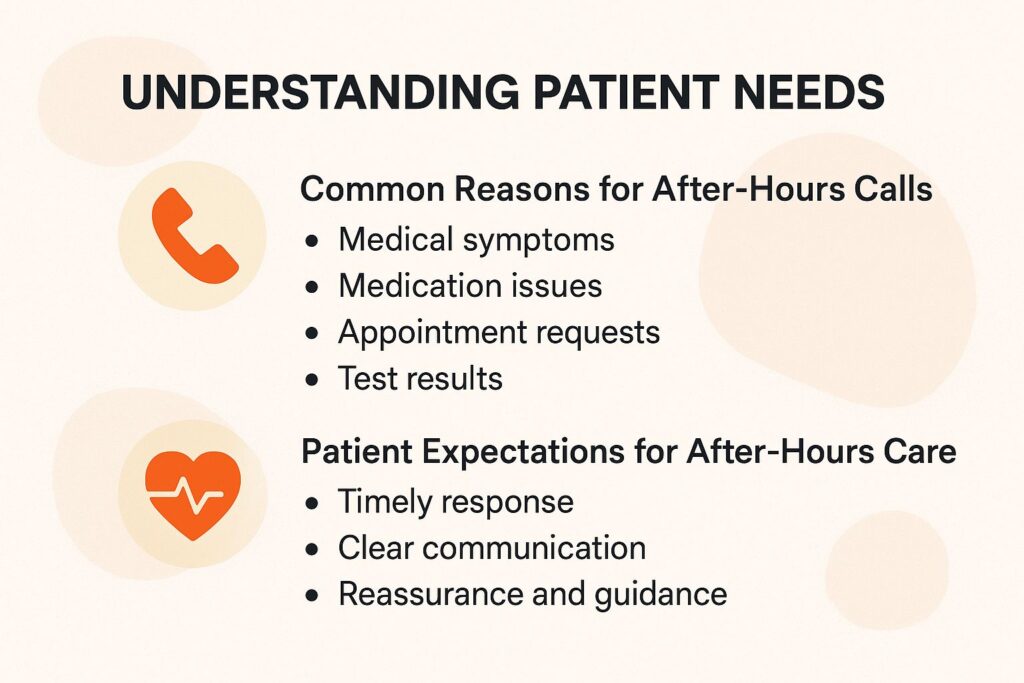
Knowing why after-hours calls happen helps healthcare providers respond with specific solutions that improve patient satisfaction and operational efficiency. In this context, medical answering services play a crucial role in enhancing practice attractiveness. Learn more about how these services can make your practice the top choice for patients.
Common Reasons for After-Hours Calls
Patients frequently call after hours for various reasons, including urgent queries, medication refills, and appointment scheduling.
Common reasons for these calls include:
- Serious health problems that appear suddenly, like intense pain or bleeding.
- Questions about medication side effects, asking for comfort or guidance.
- Requests for prescription refills, particularly for chronic conditions where dosages are time-sensitive, require effective staff training and call tracking.
- Need to reschedule or confirm appointments that patients were unable to address during regular office hours.
- Inquiries regarding test results that were not communicated during previous visits.
Meeting these needs is important because quick replies can greatly improve patient happiness, health results, and service excellence.
Patient Expectations for After-Hours Care
Patients want quick answers and kind support when they call after hours because they need to feel safe and confident, enhancing their patient experience.
To meet these expectations, practices should set up clear response procedures and use call management software. For instance, consider setting a standard that at least 75% of calls are returned within 15 minutes.
Using communication tools like a special phone system with voicemail sorting can make this process simpler and improve service level agreements. Teaching employees how to communicate with empathy is important for enhancing customer service and communication compliance. Practicing through role-play can help them learn these skills.
Checking patient feedback consistently for satisfaction levels helps make things better, improving call disposition and patient follow-up. This means your practice can quickly address issues while showing compassion, which is key to building trust over time.
Legal and Regulatory Framework

Knowing the legal requirements for after-hours patient care helps follow regulations and keeps both patients and providers safe, mitigating legal implications. For an extensive analysis of the latest legal updates, our comprehensive review on medical ethics and regulations explores recent changes and their impact.
HIPAA Compliance Considerations
HIPAA mandates strict confidentiality measures, requiring healthcare providers to safeguard patient information during after-hours interactions.
When handling calls outside usual hours, providers must keep shared information compliant with HIPAA regulations to protect data security and patient confidentiality.
For instance, patient information can be shared if the patient has given consent or if it pertains to treatment continuity. Staff should use secure communication methods, such as encrypted emails or HIPAA-compliant messaging apps.
For more details, the Department of Health and Human Services (HHS) website offers detailed resources and guidelines on allowed disclosures and protections to help healthcare providers follow these important rules.
State Regulations on After-Hours Care
State regulations vary widely, with some requiring healthcare providers to offer 24/7 support and access to care or have designated on-call physicians.
For instance, California mandates that all hospitals have a licensed physician on call at all times, while Texas requires healthcare facilities to provide emergency care services around the clock, ensuring patient access regardless of the hour.
In contrast, New York’s regulations emphasize proper staffing and the availability of critical care specialists during off-hours. Providers can check compliance guidelines by visiting state health department resources such as California’s Department of Public Health or Texas Health and Human Services for the most current regulatory standards.
Documentation and Record-Keeping Requirements
Make sure to correctly log calls that occur after normal business hours. Guidelines recommend that all calls should be documented within 24 hours.
To make sure documentation is done well, use Electronic Health Record (EHR) systems such as Epic or Cerner. These systems offer forms for logging interactions fast and precisely.
When logging, include specific details such as patient name, call reason, and any pertinent advice given.
Make your process consistent by creating a checklist that includes important details like timestamps and follow-up actions, to make sure your documentation is strong. This approach makes communication easier for healthcare providers and helps improve patient care results over time.
Establishing a Compliance-Friendly Protocol

A clear plan for handling patient calls outside of regular hours can make things easier and keep standards high, facilitating patient care compliance.
Creating a Standard Operating Procedure
Developing a Standard Operating Procedure (SOP) for after-hours calls can standardize responses and improve patient outcomes.
Begin by outlining the key components of your SOP, focusing on patient care coordination and call escalation procedures. Start with a detailed contact list that includes key personnel and their roles during after-hours.
Next, establish communication protocols that dictate how calls should be answered, including a script for consistency and call analytics.
It’s important to know when to involve a supervisor right away. Identify which situations need their immediate attention.
Include guidelines for documenting calls and follow-up actions.
Put the SOP on a shared online platform for easy access, and review it every three months to update it with any changes in policy or staffing.
Training Staff on Compliance Practices
Regular training programs on compliance practices are essential for staff, contributing to a culture of accountability and quality care.
Using platforms like HealthStream, costing $29 per user each month, helps organizations deliver compliance training well and improves staff development.
Schedule these training sessions every three months to update staff on rules and procedures.
To evaluate effectiveness, implement pre- and post-training assessments, tracking improvements in compliance knowledge and healthcare administration skills. Monitor on-the-job performance metrics post-training to gauge long-term retention.
This approach increases responsibility and develops a competent workforce, leading to better patient care, safety, and healthcare call handling.
Technology Solutions for Patient Calls

Using healthcare technology can make managing after-hours patient calls better, increasing how well things run and how happy patients are. It’s important to note that these improvements often stem from adopting tips for streamlining operations within medical practices.
Using Telehealth Platforms
Telehealth platforms, like Doxy.me (free-$50/month), allow healthcare providers to hold online consultations easily during off-hours, promoting continuity of care and remote care.
Some other options are:
- Zoom for Healthcare, known for strong security and HIPAA compliance
- Amwell, which includes scheduling and billing features
Doxy.me is easy to use because it doesn’t need any downloads, which is convenient for both healthcare professionals and patients.
Each platform boosts patient participation with features like automatic appointment alerts and easy document links, enabling healthcare workers to focus more on patient care rather than paperwork.
Implementing Call Routing Systems
Implementing call routing systems, like RingCentral ($19.99/month/user), can significantly improve response times and patient experiences, enhancing workflow optimization.
These systems direct calls to the appropriate departments based on preset criteria, streamlining communication.
For instance, a healthcare facility utilizing RingCentral witnessed a 30% reduction in wait times after integrating its intelligent call routing feature, showcasing improvements in communication strategy.
Zendesk helps with patient support and patient inquiries by bringing together questions and keeping track of results.
A case study from a local clinic showed that implementing such systems led to a 50% increase in patient satisfaction scores within six months. This improves how smoothly things run and helps build stronger connections with patients, supporting patient outreach and satisfaction surveys.
Communication Strategies

It’s important to have clear ways of communicating through multi-channel communication to handle patient calls after office hours with care and professionalism.
Effective Voice Messaging for Patients
Messaging for patients should be clear and empathetic, incorporating standard phrases that help manage expectations during after-hours interactions, ensuring HIPAA compliance.
Consider using templates like:
- `Thank you for reaching out. We understand that your concern is important and will respond as soon as possible.’
- `If this is an emergency, please dial 911 or visit your nearest emergency room.’
These phrases maintain empathy while guiding patients towards the right action, utilizing call recording features for quality assurance. Healthcare providers like Mercy Health have implemented similar messaging strategies, resulting in a 20% increase in patient satisfaction scores during after-hours communication.
Tools like Twilio can help manage these messages, allowing quick replies to patient questions through a telecommunication system.
Handling Sensitive Patient Record Management
Managing private patient details involves following strict rules to maintain privacy and meet legal requirements.
Start by implementing secure communication tools, such as encrypted messaging platforms like Signal or WhatsApp, to prevent unauthorized access.
Teaching employees, including patient representatives, is important; make sure they know privacy rules and can use these tools well.
Regularly review and update protocols-specific guidelines for handling electronic health records (EHR) can include:
- Limiting access based on roles
- Doing regular checks to find possible security breaches
Establish a culture of accountability, encouraging staff to report concerns without fear of repercussion.
Monitoring and Evaluation

Regularly checking and assessing how after-hours calls are managed can show where things can be better and improve the quality of patient care with effective triage protocols. This approach aligns with the strategies discussed in our exploration of HIPAA-compliant communication, which ensures patient privacy is maintained during after-hours interactions.
Tracking Call Outcomes
Using a call outcome tracking system in a call center can provide helpful details about patient interactions, improving service delivery.
To set up an effective tracking system, begin by defining key metrics such as response times, call resolution rates, and patient satisfaction scores.
Use Google Sheets to create a simple database to log calls and review information easily. To make your work easier, think about using tools like CallRail or Aircall. These tools automatically record call details and give you detailed analysis.
Check this data often to find patterns and spots that need changes, which will improve the patient experience.
Regular Compliance Audits
Regular compliance checks are important to make sure healthcare rules and procedures are followed during after-hours calls.
To thoroughly check compliance, review call records to confirm they follow HIPAA rules, assess staff training on emergency plans and procedures, and check that patient information is managed properly.
Frequency should be quarterly to maintain ongoing compliance. Use tools like ComplyAssistant to check compliance numbers and CallRail to look over call information.
Using technology to handle these tasks reduces manual checks, ensuring your audit results are accurate and helpful, which makes the environment safer for both staff and patients.
Summary of Best Practices
Important practices include setting clear rules, providing regular training, and using good communication methods to improve patient care.
To put these best practices into action, start by setting clear communication rules, like standard handoff steps and appointment follow-ups, to make sure important information is not missed when shifts change.
Regular training sessions should include role-playing exercises to help staff practice these protocols in real-life situations.
Using group tools like Slack or Microsoft Teams lets team members communicate instantly, ensuring everyone shares the same information.
By using these methods together, healthcare teams can make a big difference in patient results and make their work processes more efficient.
Thoughts on After-Hours Care
In the coming years, new developments in remote healthcare and online communication will change how patients are cared for outside regular hours.
Patients are now looking for quick replies and custom care, pushing healthcare providers to use new telehealth systems.
For instance, utilizing apps like Teladoc enables clinicians to manage patient inquiries effectively outside of normal hours.
Integrating AI chatbots, such as Ada Health, can offer preliminary assessments and direct patients to appropriate resources instantly.
Using these technologies helps meet new rules and improves how happy patients are.
Ongoing training for healthcare staff on these tools is needed to keep up high-quality care and quick response in this changing field.
About the Author
I’m Keith Chambers, a Princeton University graduate with a bachelor’s degree in human resource management and psychology. I’ve owned a successful medical answering service company in California for 20 years, specializing in emergency call handling, healthcare communication, and patient access solutions. I’m also a contributing writer for Medical Call Service, where I help practices streamline communication and improve patient outcomes through better service design.
Leave a Reply