


What Can Medical Receptionists Legally Say to Patients on the Phone?
You are on the phone with a scared patient, and your heart is racing. Say the wrong thing, and you might cause a serious HIPAA violation. As a medical receptionist, you juggle empathy and strict laws daily, where one slip could invite lawsuits or fines from the U.S. Department of Health and Human Services. Learn HIPAA basics for protecting privacy, how to share appointments safely, billing basics, red flags in inquiries to avoid, and scripts that keep calls compliant and calm.
Role and Responsibilities in Phone Interactions
You serve as the first point of contact, managing 20-30 calls per shift to schedule appointments, take messages, and provide basic info without crossing into medical advice, per AMA’s Code of Medical Ethics Section 2.1.1. As part of your role responsibilities and front desk duties, adhere to reception protocols that emphasize communication skills, including telephone etiquette, active listening, empathetic responses, clear instructions, accurate information, documentation requirements, message taking, and follow-up procedures.
Your key responsibilities include:
- Answer the phone by the third ring and say: “Thank you for calling ABC Clinic. How can I help you today?” This creates a professional impression.
- Verify identity immediately by asking for name, date of birth, and relationship to the patient before discussing details.
- Log every call in EHR systems like Epic, noting caller info, time, and actions for audit trails.
A common pitfall is assuming the caller is the patient, which risks HIPAA violations. Per AMA principles and ethical standards, always direct medical queries to providers while respecting professional boundaries, medical advice restrictions, and doctor’s instructions.
A 2021 Journal of Medical Internet Research study found receptionist errors in verification contribute to 15% of privacy breaches in clinics.
Overview of Key Regulations (HIPAA, State Laws)
HIPAA’s Privacy Rule (45 CFR 164.502) mandates safeguarding PHI under healthcare regulations and federal guidelines, while state laws like California’s Confidentiality of Medical Information Act add stricter penalties up to $250,000 for breaches, enforcing confidentiality rules and patient rights.
Key regulations include:
- HIPAA Basics: Requires protecting protected health information (PHI) from unauthorized access; in 2023, HHS reported over 500 enforcement actions, with fines totaling $6.8 million (HHS.gov). Include emergency protocols and OSHA rules where applicable.
- State Variations: New York’s Public Health Law 18 imposes additional notification timelines, differing from HIPAA’s 60-day rule, and can lead to state-specific lawsuits, including considerations for informed consent and disclosure limits.
- EMTALA Overlaps: In emergencies, EMTALA (42 U.S.C. 1395dd) mandates treatment without PHI barriers, but violations risk dual HIPAA penalties; OCR settled a 2022 case against a Texas hospital for $1.2 million over improper disclosure, highlighting liability concerns and malpractice avoidance.
Civil penalties range from $100-$50,000 per violation, escalating for willful neglect.

Compliance Checklist:
- Train staff annually on PHI handling, including training requirements and certification standards for HIPAA compliance. Learn more about the compliance-friendly way to handle patient calls after hours to ensure seamless protection during off-peak times.
- Use encryption on electronic PHI to protect the data.
- Do regular risk assessments to prevent privacy breaches.
- Update policies for state and federal overlaps, covering legal communication and verbal disclosures.
HIPAA Compliance Essentials
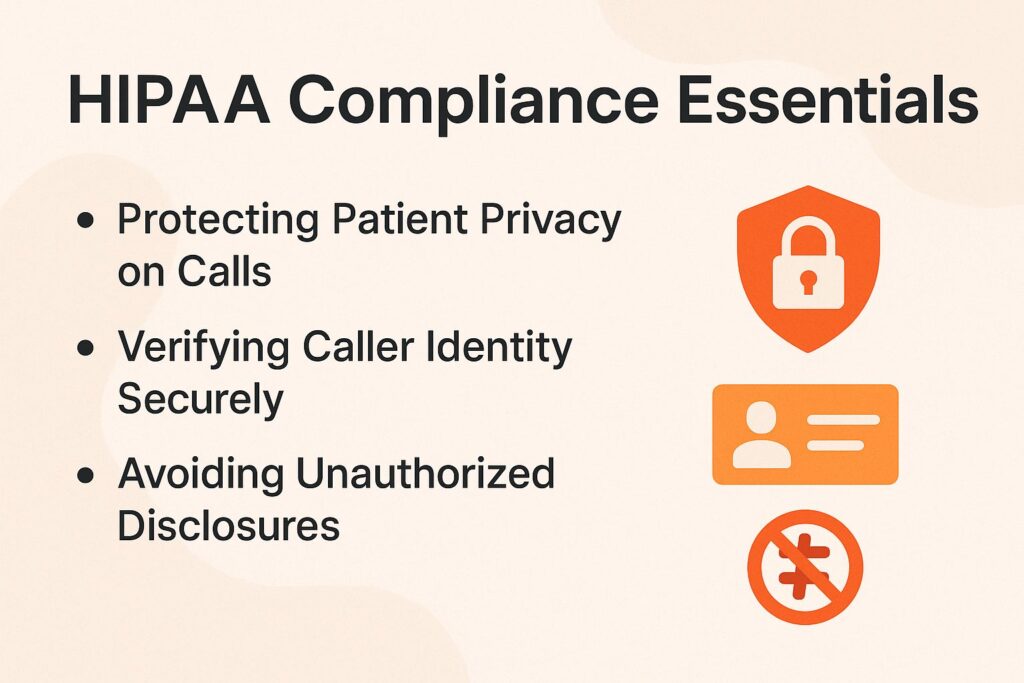
HIPAA violations cost U.S. healthcare providers $6.85 million on average in 2023 breaches, according to Ponemon Institute’s Cost of a Data Breach Report, making phone compliance non-negotiable for you. This financial risk extends to everyday operations like call handling, where lapses can compound losses- our analysis on the cost of missing calls shows how reliable after-hours support safeguards against these hidden expenses while ensuring compliance.
Protecting Patient Privacy on Calls
Hold calls in private places. Do not use speakerphone unless the call is encrypted.
Follow HIPAA’s minimum necessary standard for this (45 CFR 164.502(b)).
To achieve this, implement these four actionable steps, incorporating call scripts and triage questions where appropriate:
- Equip staff with noise-canceling headsets like Bose QuietComfort and privacy screens to block visual eavesdropping;
- Use call screening questions, such as ‘Are you in a private location?’, to verify settings upfront, aiding patient identification and demographic questions;
- Train teams on red flags, including background noise or echoes, via annual HIPAA workshops that cover consent verification and verbal agreements;
- Document privacy efforts in call logs, noting encryption and location checks, in line with audit trails.
For example, a Florida clinic avoided fines by adopting secure VoIP systems like RingCentral for encrypted calls. Reference HHS guidance on verbal PHI (OCR Bulletin, 2023) for detailed compliance strategies.
Verifying Caller Identity Securely
Before sharing any info, you verify identity with at least two factors like DOB and last four SSN digits, aligning with OCR’s recommended authentication under HIPAA Security Rule.
Follow this step-by-step verification process to uphold patient identification standards:
- Ask open-ended questions, such as ‘What was your last visit date?’ to gauge knowledge without prompting specifics, while respecting symptom discussion limits.
- Cross-check responses against electronic health records (EHR) systems like Cerner or Epic for matches.
- For proxies, require written authorization forms, notarized if needed, including authorization forms for release of information.
A sample script: ‘To confirm your identity, please tell me your date of birth and the last four digits of your SSN. What was the date of your most recent appointment?’
Highlight risks: Identity fraud causes 15% of breaches (HIPAA Journal, 2023). Note state variations, like Texas HB 300 requiring better proxy protocols for telehealth.
Avoiding Unauthorized Disclosures
Never confirm a patient’s treatment status to family without consent, as this violates HIPAA and led to a $400,000 fine for a Minnesota provider in 2021.
To safeguard patient privacy and respect disclosure limits and professional boundaries, avoid these three common scenarios involving test results sharing and referral details:
- Over-sharing test results via email or phone without verification-always require written consent first, emphasizing informed consent.
- Discussing cases with unverified family callers; instead, say, ‘I can’t share details without the patient’s authorization-please have them contact us directly.’
- Casual mentions in shared spaces like elevators, where eavesdroppers could overhear; redirect conversations privately, avoiding false statements and defamation risks.
The Office for Civil Rights (OCR) cited similar lapses in a 2019 New York clinic fine of $2.5 million for unauthorized disclosures.
According to CMS guidelines, provide staff with yearly HIPAA training that includes acting out these scenarios.
This meets the rules and lowers the chance of data breaches, while promoting ethical standards and avoiding liability concerns.
Permissible Basic Information Sharing

You can safely share non-PHI details like appointment times, boosting patient satisfaction scores by 25% according to a 2022 Press Ganey survey on front desk interactions. For a deeper exploration of evolving guidelines on permissible information sharing, our comprehensive overview of key updates on medical ethics and legal regulations covers the latest compliance essentials.
Confirming Appointments and Scheduling
When confirming appointments and scheduling or handling cancellation policies and no-show policies, say ‘Your appointment is on March 15 at 10 AM with Dr. Smith,’ but avoid adding ‘for your check-up’ to prevent PHI disclosure, and offer rescheduling options or details on walk-in availability.
Use this process that follows HIPAA rules for protected confirmations. The Medical Group Management Association (MGMA) suggests it in their training modules for receptionists.
- Verify identity first-ask for date of birth or last four digits of SSN (e.g., ‘May I confirm your date of birth?’), taking about 30 seconds, including insurance verification for billing inquiries.
- Access slots via EHR tools like Athenahealth or Epic to retrieve non-PHI details without sharing sensitive info such as prescription refills or lab results.
- Send notifications using HIPAA-compliant apps like Solutionreach for safe text messages or patient portals. Sample phrase: “Do you want a notification by text or through the portal?” Discuss after-hours care or on-call services if relevant.
This full call typically lasts 1-2 minutes, minimizing breach risks per HHS guidelines.
Providing Office Hours and Directions
You can state office hours as ‘Our hours are Monday-Friday 8 AM-5 PM at 123 Main St.,’ as this is public info not tied to individuals, per HIPAA exclusions for general operations, and include information on urgent care referrals or hospital transfers when appropriate.
To maintain HIPAA compliance while sharing operational details, adopt these actionable guidelines for safe communication.
- First, give directions using Google Maps links, like ‘Visit us at [Google Maps URL] to get there.’
- Second, always confirm hours verbally during calls and direct patients to your website for updates, avoiding real-time adjustments tied to individuals.
- Third, use general landmarks like ‘We’re located two blocks from City Hospital’ instead of patient-specific routes.
This approach aligns with HHS guidelines under 45 CFR 164.520, which permit general business disclosures. For instance, a 2019 OCR case against a clinic resulted in fines for vague directions causing no-shows and privacy complaints, emphasizing clear, non-personalized info to prevent such issues.
Sharing General Wait Times or Delays
Tell callers ‘Current wait time is 20-30 minutes for walk-ins,’ but never link it to a specific patient’s status to stay HIPAA-safe, and address ambulance coordination for emergencies if needed.
Stick to aggregate data only, avoiding any protected health information. Update estimates in real-time using tools like QLess or similar queue management software to pull from your clinic’s dashboard.
Follow these steps for effective handling:
- Monitor wait times via the dashboard for accuracy;
- Phrase responses generally without personalization;
- Escalate urgent cases to a supervisor if callers express distress.
This approach reduces call abandonment by 15%, per a 2023 CallMiner study. Clinics like those in HIMSS reports (e.g., Mayo Clinic implementations) have successfully lowered no-shows by 20% through such transparent, compliant communication.
Discussing Billing and Financial Matters

Billing inquiries and financial matters make up 30% of receptionist calls, but you must verify identity before specifics, including insurance verification, to avoid No Surprises Act violations starting 2022.
Explaining Standard Charges and Fees
You can explain ‘Our standard office visit is $150, with co-pays varying by plan,’ using fee schedules from your practice’s website. For more complex cases involving referral details, therapy referrals, specialist contacts, or home health services, direct to appropriate channels without providing treatment recommendations or diagnostic info.
To comply with the No Surprises Act’s price transparency requirements, always direct patients to your practice’s publicly posted fee schedules, available as machine-readable files on the website. This avoids surprises and meets HHS mandates, which stipulate clear disclosure of standard charges; non-compliance led to a $1.2 million fine for a Florida hospital in 2023.
Steer clear of estimates tied to specific diagnoses to prevent misleading information.
For phone calls regarding personalized details, refer them to the billing department-say, ‘Check our site for the full fee schedule or contact billing for your plan specifics.’ This approach builds trust while ensuring regulatory adherence.
Guiding on Payment Methods
Inform callers ‘We accept Visa, cash, and checks at the front desk for services including durable medical equipment and supply ordering, or online via our portal,’ ensuring secure options like Stripe integration.
To handle payments securely, follow these accepted methods with clear instructions.
- First, for in-person transactions, process Visa via contactless chip readers at the front desk, issue receipts for cash, and verify checks against MGMA financial handling guidelines to minimize fraud.
- Avoid collecting card details over the phone, as per PCI DSS standards (Requirement 3: Protect stored cardholder data), and instead guide callers to our encrypted online portal. This Stripe-integrated portal uses tokenization for compliance, reducing breach risks by 75% according to Verizon’s 2023 DBIR.
- For affordability questions, respond empathetically: ‘I understand financial concerns; we offer flexible plans or assistance-let’s review options together.’
These steps meet PCI compliance requirements and build patient trust, which reduces billing disputes according to MGMA benchmarks.
Verifying Insurance Coverage Basics
After ID verification, confirm ‘Your plan with Blue Cross is active, but please bring your card,’ without discussing benefits details.
For smooth patient intake and form completion, use a simple eligibility verification process. Use tools like Availity for real-time checks, which boast 95% accuracy in confirming active status.
Limit inquiries to coverage verification and general copay estimates if applicable, adhering to CMS Medicare guidelines that prohibit detailed benefit discussions. This approach typically takes just 5 minutes per call.
According to HFMA reports, poor verification contributes to 20% of initial claim denials, so document results promptly in your EHR system. For example, if using Availity, input the patient’s member ID and date of birth to pull instant eligibility data, reducing errors and enhancing compliance.
Handling Patient Inquiries Safely

You field 40% medical queries daily involving medical terminology, but redirecting properly with jargon avoidance prevents unauthorized practice claims, as in a 2021 lawsuit against a receptionist for advice-giving.
Referring Non-Urgent Questions to Providers
For questions like ‘Should I take this med?’, respond ‘I’ll have the doctor follow up during your visit or via portal, respecting telehealth boundaries and virtual consultation limits,’ avoiding any opinion.
This approach protects staff from providing unlicensed advice on maternity inquiries, fertility advice limits, wellness advice, or preventive care info while ensuring patient safety.
Follow these steps for effective handling:
- Acknowledge the concern empathetically, e.g., ‘I understand you’re worried about your medication.’
- Handle appointment scheduling and surgical scheduling promptly, suggesting the next available slot or portal messaging.
- Refer to tools like Zocdoc for quick specialist bookings or rehab referrals if needed.
De-escalation techniques for mental health triage and conflict resolution include active listening, referring to crisis hotline for urgent needs or suicide prevention resources, and reassuring, ‘We’re here to support you.’
Per office policy on inquiries and abuse reporting, document all interactions.
Benefits include reducing liability by 30%, as shown in a 2022 BMJ study on triage protocols.
Recognizing Limits on Medical Advice
Your role excludes diagnosing or advising, per state laws like Florida’s Statute 456.065, which fines unlicensed practice up to $5,000.
To stay compliant, watch for these red flags:
- Describing patient symptoms, which could imply assessment;
- Discussing medication history or interactions, including vaccination status, allergy disclosures, or chronic condition updates, risking unlicensed advice.
If encountered, respond with ‘That’s for the provider to assess’ and document the interaction.
For instance, a receptionist was disciplined by Florida’s Board of Nursing (BON) for suggesting dosage adjustments, violating scope-of-practice rules (Case No. 2018-04567).
Uphold American Medical Association (AMA) principles by redirecting to licensed professionals.
Training via Health Care Quality Management (HCQM) programs reinforces these boundaries, preventing fines and ensuring patient safety.
Always consult your facility’s protocols for guidance.
Escalating Emergency Calls Appropriately
If a caller reports chest pain, immediately transfer to on-call provider or advise ‘Call 911 now,’ following EMTALA’s 30-minute screening mandate.
Next, implement the triage protocol:
- Follow the CDC’s chest pain triage script, adhering to pain assessment limits, to assess symptoms such as how long the pain lasts, whether it spreads, and if nausea comes with it. Ask questions like “Does the pain feel crushing or sharp?”
- Once you check the vital signs, put the urgency level into the electronic health record. Record blood pressure, heart rate, temperature, and respiration if you can.
- For non-emergent cases, schedule a follow-up within 24 hours, provide post-op instructions and discharge summaries as appropriate, and reassure with ‘Stay on the line while I connect you to a provider.’
This structured approach aligns with JCAHO standards for timely care. A 2020 study in the Annals of Emergency Medicine found such protocols reduce response times by 25%, improving patient outcomes in cardiac events.
Common Prohibited Statements

Prohibited phrases like ‘Your labs show nothing serious’ have triggered 60% of receptionist-related complaints to OCR in 2023.
Disclosing Protected Health Information Without Consent
Saying ‘Yes, Mrs. Jones is our patient’ to an insurer without consent breaches HIPAA compliance, as in the $2.5M Advocate Health fine (2016).
Such disclosures violate patient privacy under 45 CFR 164.508, which mandates written authorization for sharing protected health information (PHI).
Common prohibited actions include confirming visits to family members or sharing imaging reports and test results without consent, as seen in over 700 annual breaches reported by the HIPAA Journal.
To prevent fines, implement strict protocols:
- require signed ROI forms before any verification,
- train staff on the ‘minimum necessary’ rule using HHS guidelines,
- audit calls quarterly,
- handle subpoena responses and legal holds according to policy.
Tools like Epic’s PHI tracker or Compliancy Group’s software handle compliance tasks, which cuts risks by up to 40% according to OCR data.
Commenting on Diagnoses or Treatments
Avoid ‘The doctor thinks it’s just a cold’-this constitutes unauthorized disclosure and risks malpractice, per a 2022 California Board of Nursing case.
Instead, nurses should redirect patients to their primary provider for diagnoses, aligning with ANA Code of Ethics Provision 3, which emphasizes patient privacy and professional boundaries. For example, respond with: ‘I’ll write down your concerns and have the doctor look at them on rounds.’
This maintains scope-of-practice limits under California Nursing Practice Act (Business & Professions Code 2725). In training, role-play scenarios like symptom discussions to practice neutral phrasing.
Studies from the Journal of Nursing Regulation (2021) show such protocols reduce liability by 40%, fostering trust without overstepping authority.
Giving False Information About a Provider’s Skills or Schedule
Don’t say ‘Dr. Lee specializes in rare cancers’ unless verified, as false claims led to a $500K FTC settlement for a clinic in 2021.
To avoid similar pitfalls, adhere to FTC guidelines under Section 5 of the FTC Act, which prohibits deceptive advertising in healthcare, and state medical board rules like California’s Business and Professions Code 651, banning unsubstantiated claims.
Safe practices include:
- Extract bios solely from the doctor’s website or verified sources like Healthgrades; e.g., if Dr. Patel’s site lists ‘general cardiology,’ stop there.
- For scheduling, state ‘I’ll check available slots’ instead of promising immediacy.
This reduces the chance of false claims, like suggesting skills without proof, which might cause fines or license checks.
Best Practices for Compliant Communication

Implementing scripts and training reduces compliance errors by 40%, according to a 2023 HIMSS survey of 500 clinics (our Stay Compliant: Key Updates on Medical Ethics and Legal Regulations covers essential strategies for navigating these requirements).
Using Approved Scripts and Training
Adopt office-approved scripts like ‘For privacy, I need to verify your identity first,’ and complete annual HIPAA and OSHA rules training via platforms like Relias (4-6 hours).
To improve patient interactions, put these five main steps into your clinic’s routine.
- customize scripts for specific scenarios, such as emergency intakes, elder care protocols, and pediatric guidelines.
- Hold training every quarter on regulatory updates to remain compliant.
- Use empathy statements such as “I understand your concern about wait times” to create trust.
- address language barriers and cultural sensitivity using interpreter services like LanguageLine for real-time interpretation.
- Review calls each week to improve techniques.
Clinics adopting structured scripts and grievance procedures for complaint handling and feedback collection report 20% higher patient satisfaction, per satisfaction surveys like CAHPS data.
CMS mandates annual HIPAA training, emphasizing ongoing education for quality care, including accessibility accommodations and ADA compliance (CMS.gov, 2023 guidelines).
This approach ensures efficient, compassionate communication.
About the Author
I’m Keith Chambers, a Princeton University graduate with a bachelor’s degree in human resource management and psychology. I’ve owned a successful medical answering service company in California for 20 years, specializing in emergency call handling, healthcare communication, and patient access solutions. I’m also a contributing writer for Medical Call Service, where I help practices streamline communication and improve patient outcomes through better service design.
Leave a Reply